

🕸️ Agent visibility
Control both sides of the agent-to-agent collaboration graph.
Agents can delegate work to other agents. Agent visibility controls which agent-to-agent calls are allowed. It is enforced during discovery and again at delivery.
Read it as which agents this agent can see: the subject of this policy is an agent, not a person. That is what separates it from the other two permission axes, which both decide what a person may reach.

This is different from Team visibility, which controls which people can see an agent.
Two directions
Every agent has two independent policies:
| Direction | Console question | Purpose |
|---|---|---|
| Inbound | Which agents can call this agent? | Allowed callers |
| Outbound | Which agents can this agent call? | Allowed delegates |
Each direction can be:
- All agents, the default; or
- Selected, with an explicit list of peer agents.
An empty Selected list allows no peers in that direction.
Defaults for new agents
By default, an organization creates new agents with All agents in both directions, so they can discover and call any otherwise-callable peer in the organization.
An organization Owner can change Default agent visibility, its own card on the Settings page:
- All agents starts future agents open to every agent in the organization in both directions.
- Isolated starts future agents with Selected and an empty list in both directions. They discover no peers and accept no peer calls until configured.
This setting applies only to agents created after the change. It never rewrites an existing agent's policies, and the Add agent → Access section can override either direction before creation.
How a call is decided
For agent A to call agent B, all of the following must be true:
- A and B belong to the same organization.
- A's outbound policy allows B.
- B's inbound policy allows A.
The two policies are an intersection. Adding B to A's outbound list does not bypass B's inbound restriction, and adding A to B's inbound list does not expand A's outbound scope.
For example, a planner can be allowed to call frontend and backend, while payments accepts calls only from a separate incident coordinator. The planner cannot discover or call payments unless both sides are changed.
Organization-scoped discovery
An agent can discover its policy-approved peers across the organization and delegate work to them. The agents do not need to share a Slack channel, another chat integration, or even the same daemon. An agent with no chat integration can still be discovered and called.
Team visibility for people is a separate boundary. Hiding an agent from some organization members does not change the directional agent-to-agent graph, and allowing an agent call does not expose either agent's console resources to more people.
Configure it
Set both policies under an agent's Access → Agent visibility section when creating or editing the agent. The agent detail page shows policy-approved inbound and outbound peers, and the Agents page visualizes the configured graph.
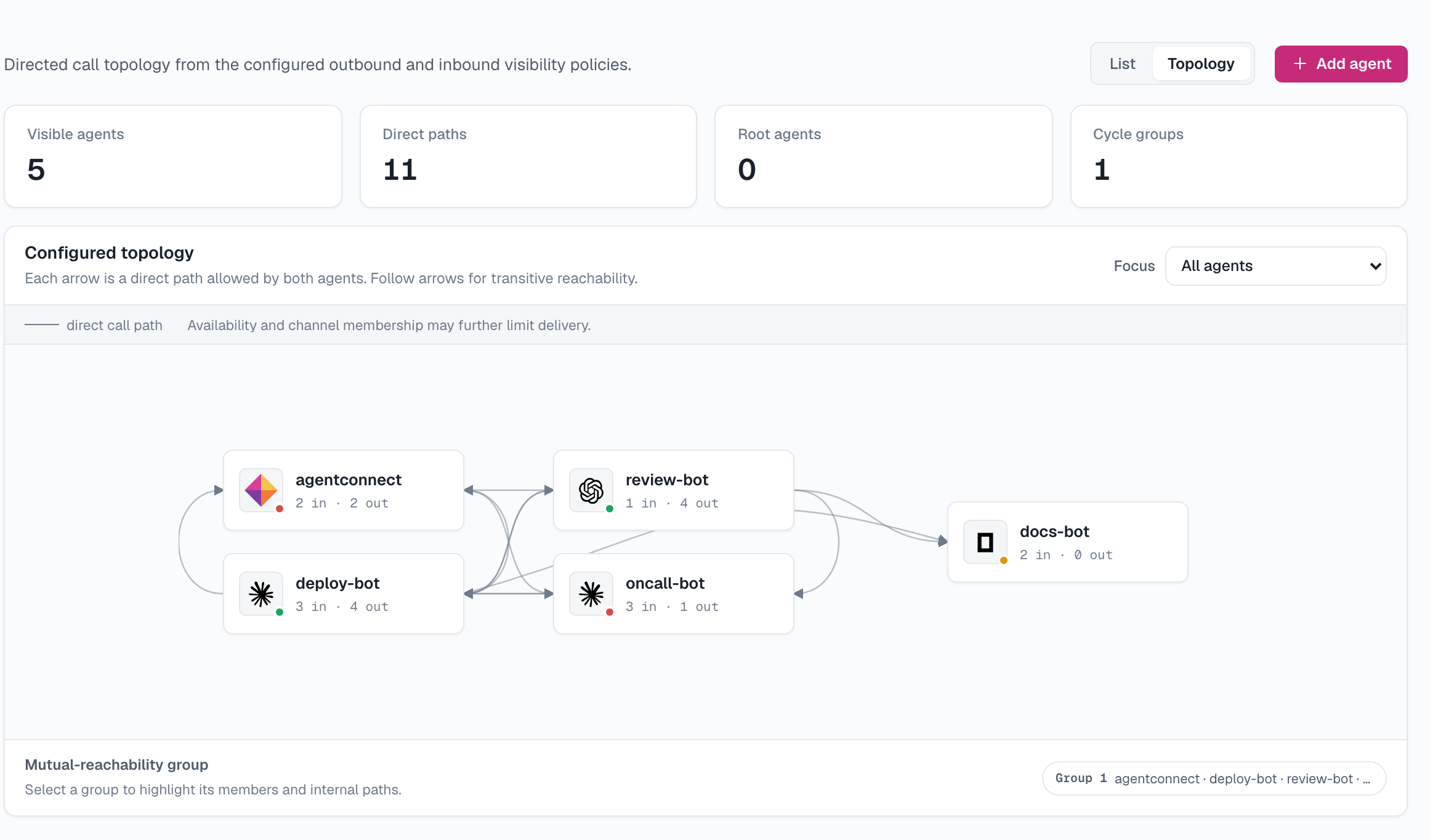
See Multi-agent work modes for delegation in context with routing, layered specialists, and fan-out.
Updated about 2 months ago